Daily is one of the simplest, yet most mechanically run events in Scrum. In many teams, it turns into a round of individual reporting from each participant. While this format can be sufficient, it often stops bringing value. The team gets bored, people stop listening, and the meeting becomes a meaningless ritual.
Fortunately, there are other ways to run daily. Approaches that engage people, shorten the meeting, and most importantly help the team deliver on the goal. This isn't about adding variety for the sake of it. It’s about changing the perspective from reporting activities to working together on outcomes.
Below are a few proven formats.
When you want to return to the product goal: daily around the sprint goal
One of the most common problems with daily is that it focuses on activities instead of results. People report what they did, but don’t necessarily reflect on whether it brings the team closer to the goal. That’s why one of the most valuable approaches is to make the sprint goal the starting point of every conversation.
Daily then begins with a simple question: what’s our sprint goal? Then the team reflects together:
where we are in relation to the goal
what we still need to achieve it
what’s slowing us down or blocking us
whether we’re doing work that isn’t related to the goal
This shifts the focus from “what I did” to “are we delivering value”. As a result, daily becomes shorter, more concrete, and much more team-oriented.
An additional benefit is that the sprint goal stops being a static element from planning and becomes an important part of everyday work.
When you want to improve flow: a Kanban approach
Another approach that works very well, especially in teams overloaded with work, is running daily based on the flow of tasks.
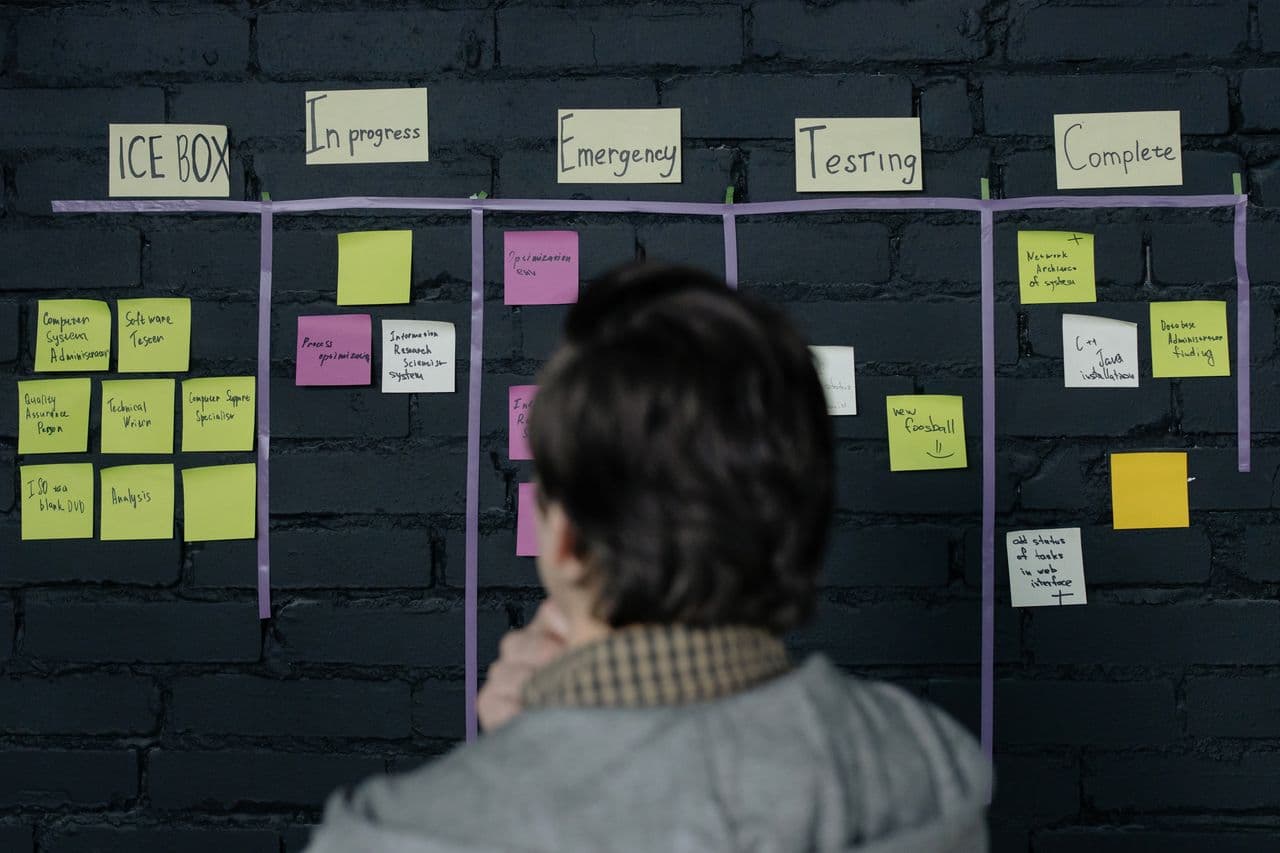
Instead of focusing on people, we focus on the work. The team goes through the board from right to left, starting with items that are closest to completion. Why from the right side? Because these are the tasks that are closest to being finished and can deliver value the fastest. For each of them, the team asks: what can we do to finish this task as quickly as possible? Only after that does the team move to the next columns.
This approach changes the mindset:
instead of starting new things, we focus on finishing what’s already been started (stop starting, start finishing)
we identify blockers faster
we naturally limit work in progress
In practice, even switching to this way of running daily often significantly improves delivery pace.
When you want to focus on workload: a Kanban approach
Sometimes the problem isn’t lack of engagement or poor communication, but simple overload. There are just too many tasks, both those actively worked on and those that got stuck somewhere and are waiting for the next step. In such situations, it’s worth using daily as a moment to pause and look at how much work we actually have.
In this approach, we move from talking about tasks to analyzing their number and status. The team looks at the board together and asks a few simple questions:
how many tasks are currently in progress
how many of them are actually moving forward
which tasks are “waiting”, either for team actions or external factors
whether we have work that was started but hasn’t moved for several days
Just becoming aware of the amount of work in progress often leads to important decisions. The team starts to notice that too many things are started and too few are finished.
The second important element of this approach is looking at how long tasks take. This isn’t about detailed metrics, but about common sense and comparing to what’s typical for the team. If something takes much longer than usual, it’s a signal that it’s worth discussing what happened and what we can do to finish it as quickly as possible. Daily becomes a space for identifying such situations and making decisions: what do we do to unblock the work and finish what we started.
This approach helps the team see not only what we’re doing, but also how much of it there is and how long it takes. That’s often the first step toward real improvement without introducing major changes.
When you want to break the pattern: nomination and random selection
One of the simplest ways to refresh daily is to move away from a fixed speaking order. It may seem like a small detail, but in practice it quickly impacts the level of attention in the team.
Instead of going one by one, one person starts and at the end of their update chooses the next speaker. Suddenly participants listen to each other, because they can be called at any moment. You can also use an online picker that selects the next person.
It’s a small change, but it significantly strengthens team ownership. These formats aren’t about entertainment. They’re about breaking automation and bringing focus back to the meeting.
When you want to break the pattern: facilitator of the day
A common problem is that daily is always led by the same person. In practice, this means that the team shifts responsibility for the meeting onto one individual and doesn’t treat it as a shared responsibility. And when that person is sick or on vacation, nobody really knows what to do.
That’s why it’s worth introducing a rotating daily facilitator. This person can be selected randomly or based on a predefined list. What matters is that it’s not always the same person.
The facilitator is responsible for:
starting and finishing the meeting
going through the tasks
keeping the pace and structure
maintaining focus
This is a very simple practice with two effects. First, it increases engagement. Second, it builds facilitation skills within the team, which are essential for self-organization.
Don't look for the perfect format
At the end, it’s worth emphasizing one thing: there’s no single “right” way to run daily. Each of the formats described above is just a tool. In some teams it’ll work very well, in others it won’t work at all. What really matters is paying attention to how the team works.
Instead of looking for the perfect solution, it’s better to experiment, for example one format per sprint. Talk with the team about what works and why you want to choose a given approach.
Daily isn’t a goal in itself. It’s just a tool that should help the team collaborate better and deliver value more effectively. If we remember this, it becomes much easier to choose a format that makes sense instead of sticking to a ritual that stopped working a long time ago. Like any tool, daily should be adapted to the work, not the other way around.